Travel Industry Outlook for 2026: Key Trends, Technologies & Market Forces Shaping the Future of Global Travel

The travel business has a lot of momentum going into 2026. Global travel demand is stabilizing after years of recovery and recalibration. Digital adoption is speeding up, and travelers are expecting more personalization, openness, and journeys that are led by experiences. New research from 2024–2025 in the travel industry makes one thing very clear: smarter technology, stronger corporate governance, and deeper integration across booking, finance, and sustainability will shape the next phase of travel.

1. Travel Demand Will Continue Rising into 2026

IATA’s 2025 traffic data shows that airline passenger traffic grew by 4.6% year-over-year in September 2025, with high load factors around the world. This pattern is likely to keep going until 2026, when airlines add more seats and routes.

Drivers of growth include:

  • Increased international mobility
  • Expanding middle-income populations
  • Recovery in long-haul travel
  • High demand in Asia-Pacific and Middle East
  • Strong outbound and inbound tourism markets

Airlines are also planning 3–4% global seat capacity growth in 2026, signaling business confidence and market stability.

2. Corporate Travel Is Returning – With New Rules

Corporate travel is not going back to the way it was before the epidemic; instead, it is becoming more planned, strategic, and policy-driven.

  • According to research in the field, global corporate travel spending is expected to reach USD 1.64 trillion by 2025 and will keep going up in 2026.
  • The most important things are sustainability, keeping costs down, and making sure policies are followed.
  • Digital-first tactics are being used by travel programs to get approvals, make sure they are following the rules, and keep track of expenses.
  • “Bleisure,” or business and leisure travel combined, is becoming more popular as employees want for longer, more meaningful vacations.
  • Businesses will want systems that are smarter, itineraries that are flexible, clear fare displays, and financial operations that operate together.

3. AI & Automation Will Become the Backbone of Travel Operations

AI usage in the travel sector is rising rapidly. Travel advisors using generative AI jumped from 41% in 2024 to 59% in 2025, with adoption expected to rise further in 2026.

AI is now powering:

  • Personalized flight and hotel recommendations
  • Automated airfare comparison
  • Quality checks & mid-office automation
  • Predictive disruption handling
  • AI chat-based itinerary support
  • Smart expense categorization

This shift marks a movement toward practical, daily-use AI, not experimental features. As labor costs rise and travelers demand instant service, automation becomes essential for travel providers, TMCs, and corporate travel programs.

4. Modern Airline Retailing & NDC Will Transform Distribution

Airline distribution is undergoing its largest structural shift in a decade. The adoption of New Distribution Capability (NDC) allows airlines to offer richer, retail-like fare content:

  • Fare families (Light / Value / Flex)
  • Ancillaries (baggage, meals, Wi-Fi, seat selection)
  • Real-time availability and dynamic pricing
  • Transparent product comparisons

NDC adoption is accelerating for 2025–2026 as airlines reduce reliance on traditional distribution and move toward direct, personalized retailing.

For travel buyers and booking platforms, hybrid content (GDS + NDC + LCC) is no longer optional – it is a competitive requirement.

5. Travel + Expense Integration Will Become a Standard Expectation

Finance teams are demanding real-time visibility and tight financial control across travel spending. Trends for 2026 include:

  • Automated reconciliation
  • Mobile-first expense capture
  • Seamless corporate card integration
  • Policy-linked expense approvals
  • Centralized reporting for tax, audit, and compliance

As firms scale globally, manual expense workflows will be phased out.
Integrated travel + expense platforms will dominate the enterprise space.

6. Sustainability Will Shape Travel Policies & Behavior

Sustainability has moved from a talking point to an operational requirement. By late 2024:

  • 46% of travel managers ranked sustainability as a high priority
  • 44% had already started implementing sustainability-focused travel policies

Airlines, governments, and global travel groups continue pushing for:

  • More Sustainable Aviation Fuel (SAF) adoption
  • Clear carbon reporting
  • Lower-impact travel routes
  • Eco-friendly hotel and ground transport preferences

Travelers themselves – especially younger demographics – are embracing low-impact tourism, meaningful experiences, and environment-conscious travel choices.

In 2026, sustainability will strongly influence travel approvals, supplier selection, and corporate travel frameworks.

7. Personalized & Experience-Led Travel Is Becoming the Norm

Current travel behavior shows a clear shift toward personalization and experience-centric planning.

Recent trends include:

  • Strong demand for custom itineraries
  • Flexible booking and cancellation policies
  • Growth in bleisure and extended stays
  • Preference for local, authentic travel experiences
  • Digital-first planning and mobile app usage

Travelers expect more than just a list of options – they want relevant recommendations, transparency, and options aligned with their personal preferences and company policies.

Industry Implication: Travel Tech Must Rapidly Evolve

With so many moving parts – hybrid distribution, AI, sustainability, corporate controls, and global expansion – the travel industry needs platforms that offer:

  • Unified booking + expense + accounting workflows
  • Automated mid- and back-office processes
  • NDC + GDS + LCC + direct contract support
  • AI-based personalization and smart search
  • Compliance-driven travel policies and approval chains
  • Real-time financial visibility for finance teams
  • Scalable architecture for large TMCs and corporates

This is the foundation required to manage the next generation of global travel efficiently.

Conclusion: What 2026 Means for Travel Stakeholders

Travelers will expect seamless personalization and friction-free booking. Corporates will demand control, compliance, and sustainability. Agencies & TMCs will lean heavily on automation and integrated workflows. Airlines & suppliers will push richer retailing through NDC.

The industry in 2026 is not just growing – it is fundamentally modernizing. Those who invest early in digital, AI, NDC, and integrated expense capabilities will lead this new era of global travel.

How QuadLabs’ Travel Technology is Helping Businesses Enter 2026 With Confidence

QuadLabs supports travel businesses, TMCs, and corporations with a unified, automation-driven ecosystem built for the demands of 2026. Its core platforms work together to deliver speed, accuracy, and complete control across the travel lifecycle. With smarter corporate travel & expense through our leading corporate travel platform – Travog gives companies a modern self-booking and expense platform with policy-aware search, automated approvals, traveler profiling, integrated expenses, and a seamless employee experience. Konnect.Travel powers agencies with hybrid content (GDS, NDC, LCC, direct contracts), automated markups/commissions, booking management, and finance workflows – providing the operational backbone for scalable travel businesses.

Agentic AI in Travel – The Gamechanger for Travel Platforms

For travel and hospitality organisations, the next big step is not just better chatbots or smart analytics – it’s agentic AI: systems that act on behalf of users, make decisions, execute tasks and adapt in real time. In the travel world with frequent disruptions, complex policies and high customer expectations, agentic systems promise real value.

This article explains what agentic AI means for the travel business, what to consider, how it fits into the buyer journey, and how for a product like Travog it becomes a practical differentiator.

What agentic AI means (vs generative AI)

  • Generative AI: models that generate text, images, suggestions on request.

  • Agentic AI: a system of autonomous agents that set goals (for example: “re-book this cancelled flight within budget”), plan steps, call systems, evaluate results and act with minimal human direction.

#DimensionGenerative AIAgentic AI
1Core taskCreates answersCompletes tasks
2Policy handlingSuggests onlyEnforces 100%
3Tool accessZero APIsMultiple live connections
4Human neededEvery stepOnly exceptions
5End-to-end booking7–12 minutesUnder a minute


In travel: generative AI might draft a message to a traveller; agentic AI might recognize a flight delay, check alternatives across carriers, rebook according to corporate policy, notify the traveller – all with little manual intervention.

Why travel is ideally suited for agentic AI

  • Lots of moving parts: Flights, hotels, transfers, supplier rules, corporate policies. An agentic system can pull everything together in one flow.

  • Disruption is the norm: Delays, cancellations, change of plan – if you can automate recovery, you reduce cost and improve the traveller experience.

  • High expectation of personalisation: travellers expect offers, seats, hotels, transfers tailored to their tastes and company policy. Agents can maintain preference history and proactively surface options.

For regions like India and the Gulf (UAE) where business travel is growing, and travel-SaaS is rising, the combination of scale + complexity means early movers can win. For example, SaaS travel solutions in the UAE emphasise real-time booking, policy compliance, local integration.

Practical use cases you can deploy now

  • Automated disruption handling: If a flight is cancelled, the system scans alternatives from all carriers, checks hotel/transfer implications, selects the best options, and sends the top choices for approval or auto-book.

  • Smarter shopping for corporates: The system proposes the best fares/hotels that match the traveller’s past choices + company policy + cost efficiency.

  • Proactive traveller support: Instead of waiting for the traveller to ask, the agent monitors their itinerary and sends timely messages (“Your hotel check-in starts in 2 hours, standard early-check-in available, would you like me to book?”).

  • Revenue and upsell optimisation: For hotel groups or airlines, agents can identify which travellers to offer ancillaries (meals, upgrades) and when, based on behaviour and context.

  • End-to-end self-service for managers: Travel managers can issue a single request (“Book a trip to Dubai next week with 2 nights hotel, economy + lounge access under $1000”) and the agent executes the booking, policy check, expense setup, itinerary generation.

Before you can deploy agentic AI seriously, you’ll need:

  • Clean, connected data: Traveller profiles, past bookings, company policy, supplier inventory. Without this all the “smart agent” work fails.

  • Real-time integration: Live feeds from airlines, hotels, GDS/aggregators, internal workflows.

  • Clear workflows and approvals: Decide what the agent can do automatically versus what needs human sign-off.

  • Governance and audit logs: Especially in regulated regions (UAE, India) you must show why a decision happened, how it followed policy.

  • Scalable infrastructure: Travel traffic can spike during big events, seasons, or corporate campaigns. SaaS platforms must handle this.

Especially in the UAE-SaaS market, companies emphasise cloud-based, scalable travel software that handles bookings, operations and service from anywhere.

How QuadLabs is implementing Agentic-AI based personalisation in Travog

  • Step 1 – Travog’s agentic engine tracks each traveller’s preferences (for example: “prefers non-stop flights”, “chooses specific hotel chain”, “loyalty member of X airline”) and company policy (budget, preferred carriers, seat-class).

  • Step 2 – When a booking request arises, the system identifies three optimal fare/hotel options ranked by how well they match preferences + cost + policy.

  • Step 3 – The user sees these three options with clear reasons (“Option A: lowest cost, meets your stated preference; Option B: marginally higher cost but better timing; Option C: same cost but includes lounge access and allows late check-out”).

Our approach creates speed, relevance and trust – three things that resonate with enterprise buyers in the industry.

Summary
Agentic AI is no longer a future promise; it is the decisive differentiator for every travel platform that wants to own the $42 billion Indian corporate travel market and the 21% YoY-growing GCC segment. While generative AI drafts polite emails, Travog’s autonomous agents already enforce policy, with top global suppliers and return three perfect options instantly. The platforms that master clean data, real-time integrations, and configurable guardrails today will lock in enterprise wallets for the next decade; those who wait will spend years catching up. Travog is live and scaling now; the future of B2B travel has already started; make sure your organization is in it.

House of Travel (Bahrain) partners with QuadLabs to launch a next generation Corporate Travel Platform “HOTBizz”

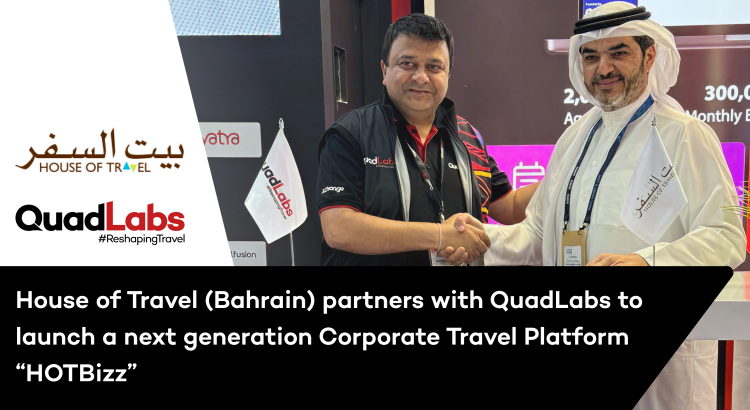
House of Travel (HOT), a leading travel management company in the Middle East, has partnered with QuadLabs, a global travel technology leader, to launch its dedicated corporate travel platform – HOTBizz. This strategic collaboration aims to elevate corporate travel management by integrating cutting-edge technology that delivers seamless, efficient, and cost-effective solutions for businesses across the region.

This partnership marks a significant milestone in the evolution of corporate travel, combining HOT’s extensive market experience with the innovative capabilities of QuadLabs. The HOTBizz platform is purpose-built to meet the dynamic needs of today’s enterprises—streamlining travel booking and administration while ensuring full compliance with corporate travel policies.

Powered by QuadLabs’ next-generation Travog system, the platform offers a robust suite of features tailored to the corporate sector. Companies can manage all aspects of their business travel through a single, intuitive interface. Key functionalities include real-time bookings, policy enforcement, expense tracking, and seamless approval workflows—delivering higher operational efficiency and a simplified user experience.

Mr. Jehad Amin, CEO- Vice Chairman of House of Travel, commented:
“We are committed to delivering forward-thinking travel solutions for our corporate clients. This partnership with QuadLabs allows us to launch a next-level platform that transforms the way businesses manage travel—enhancing cost control, compliance, and operational effectiveness.”

Mr. Gaurav Chiripal, CEO of QuadLabs, added:
“We are excited to partner with House of Travel to bring HOTBizz to life. Our mission is to empower corporate travel managers with advanced tools that redefine the travel experience—making it smoother, more transparent, and policy-compliant.”

HOTBizz is poised to reshape corporate travel management in the Middle East, further cementing House of Travel’s leadership in providing comprehensive business travel solutions.

For more information, please visit https://www.hot.bh/

About QuadLabs

QuadLabs is a global leader in travel technology and expense solutions, offering a wide range of products designed to streamline corporate travel management. With over two decades of expertise, QuadLabs delivers advanced solutions that enhance efficiency and user experience in the travel sector.

For more information, please visit https://www.QuadLabs.com

Team QuadLabs

Innovation One Building, Second Floor, DIFC, Dubai, UAE
O (IN): +91 124 663 6999, (US): +1 646 518 9528, (UK): +44 203 821 6814
(AUS): +6 125 104 2801 M(UAE): +971 567699203

QuadLabs is participating in IATA Business Travel Summit 2018

QuadLabs, a premier leader in travel technology confirms its participation at the IATA Business Travel Summit 2018 scheduled to be held at IATA Geneva Conference Center in Geneva, Switzerland on June 13th and 14th, 2018.

IATA- Business Travel Summit 2018

IATA will host the Business Travel Summit which brings over 100 representatives from a spectrum of Travel Buyers, TMCs, Airlines and IT providers. With the new guidelines and NDC perspectives from carriers, TMCs and GDS’s, it’s clear that the industry is moving towards implementation of NDC content in 2018. Industry cooperation across the business travel value chain is essential and more discussions on NDC are expected. The IATA Business Travel Summit helps in understanding latest insights from the industry value chain – airlines, IT providers, TMCs and Corporates – which will help in adoption of NDC guidelines.

Read More

QuadLabs is NDC Level 3 Certified

QuadLabs is a premier technology solution provider with a focus on delivering world-class technology products to the travel industry and is headquartered in India with sales offices in Brazil and UAE. We specialize in intelligent solutions which have a high degree of adaptability to distinct business processes within the travel domain. Our product is a proven platform with several deployments across Europe, Asia, Middle East, Australia, Africa and Latin America and is highly adapted by each market.

QuadLabs is certified NDC developer and is now IATA NDC level 3 certified. NDC is a standard prescribed by IATA for the airlines to provide direct connects to the travel agents and technology companies around the world. These standards enhances the capability of communications between airlines and travel agents by providing full and rich airline content as well as providing transparent shopping experience. Travel agents can access ancillary content along with last available seat with all possible fare types.

Read More